Weekly Leadership Digest
Counted to the Ounce
Most organizations measure what is easy to count, not what matters most. The gap between those two is where profit quietly goes.
A 3-part weekly digest from Wes & Cindy Dove
This Week's Video — Counted to the Ounce

Counted to the Ounce
By Cindy Dove
The first thing you noticed walking into the cabinet plant was the air. You felt it on your skin the moment you came through the door, warm and heavy. That was by design. Wood never stops reacting to the air around it. Let the humidity drop and a board that was straight yesterday starts to buckle, split and crack. A door that fit on Monday won’t fit by Friday. So the conditions on that floor were never left to chance.
Humidity was measured throughout the day, every day. When it dropped, a moisture system kicked on and pushed moisture back into the air. On break, when the machines went quiet, you could hear it. After I had worked there for a while, I didn’t need the reading. I could feel it on my skin when the floor was getting too dry.
When that system went down, the whole schedule changed. The wood stayed sealed in the kilns, where it could hold its moisture, and we went home early. That often meant working ten-hour shifts or the weekend to make up the time. The air determined when we worked.
We measured the air.
Think about that for a moment. We measured the air.
And we were right to. Those readings protected every board on that floor.
It wasn’t just manufacturing.
Years later in healthcare, I was the one ordering supplies. I knew what was on our shelves at any given moment, and every item was charged to the right patient, every day. Ordering once or twice a week meant reading more than the shelves: who was healing, who was getting worse and what could change quickly. When I got it right, the nurses had what they needed to care for their patients, and I had what I needed to take care of the nurses.
If you run a small business, you know that feeling. You can probably tell me right now what’s on your shelf, what’s on order and what you’ll run out of first.
Here is what I never saw counted, in either place.
Everybody knew which supervisor people asked to work with, and which one they quietly tried to transfer away from. Everybody knew whose area got the problem raised early and whose area found out when it was already expensive. You could feel the difference walking from one end of the floor to the other. Leadership made the difference.
And not one report captured it.
We knew the air on that floor to the percentage point. We knew our supplies down to the last item charged to the last patient. We never had a single number for the thing that decided whether all that measuring paid off.
We measure what is easy to count. Humidity can be read. Supplies sit on a shelf. The difference between one leader and another doesn’t hold still, so it goes unmeasured. And it quietly decides more than everything we do measure.
We counted everything that couldn’t walk out the door.
We never counted the one thing that could.
Most organizations measure what is easy to count, not what matters most. The gap between those two is where profit quietly goes.
So here is my question for you. What does your organization track most carefully? Now ask what decides whether that number is good, and whether anyone is tracking that.
If the answer is no, you’re not alone. That gap has a price, and it’s bigger than most have been willing to add up.
“We counted everything that couldn’t walk out the door. We never counted the one thing that could.”
The Intangible Excuse
By Wes Dove
A friend called me late one Friday evening more than a decade ago. At that point in my career, I would have let any other name go to voicemail. I was working 50 to 60 hours per week in my full-time role as a safety and human resource manager and every bit as much in the business Cindy and I had started a year or two prior. It had to be serious for him to be calling me at that time on a Friday. I won’t share the full story here since I’ve done so in detail previously, but one of the comments he made during that call had a direct impact on me writing What’s Killing Your Profitability? several years later. After explaining a tough conversation he had earlier in the day with the board of directors at the company where he served as CEO, a conversation that challenged him to build better relationships with the executive team members reporting to him, he told me: “I don’t have time for that touchy-feely stuff, they’re paying me to get results.”
Related Read
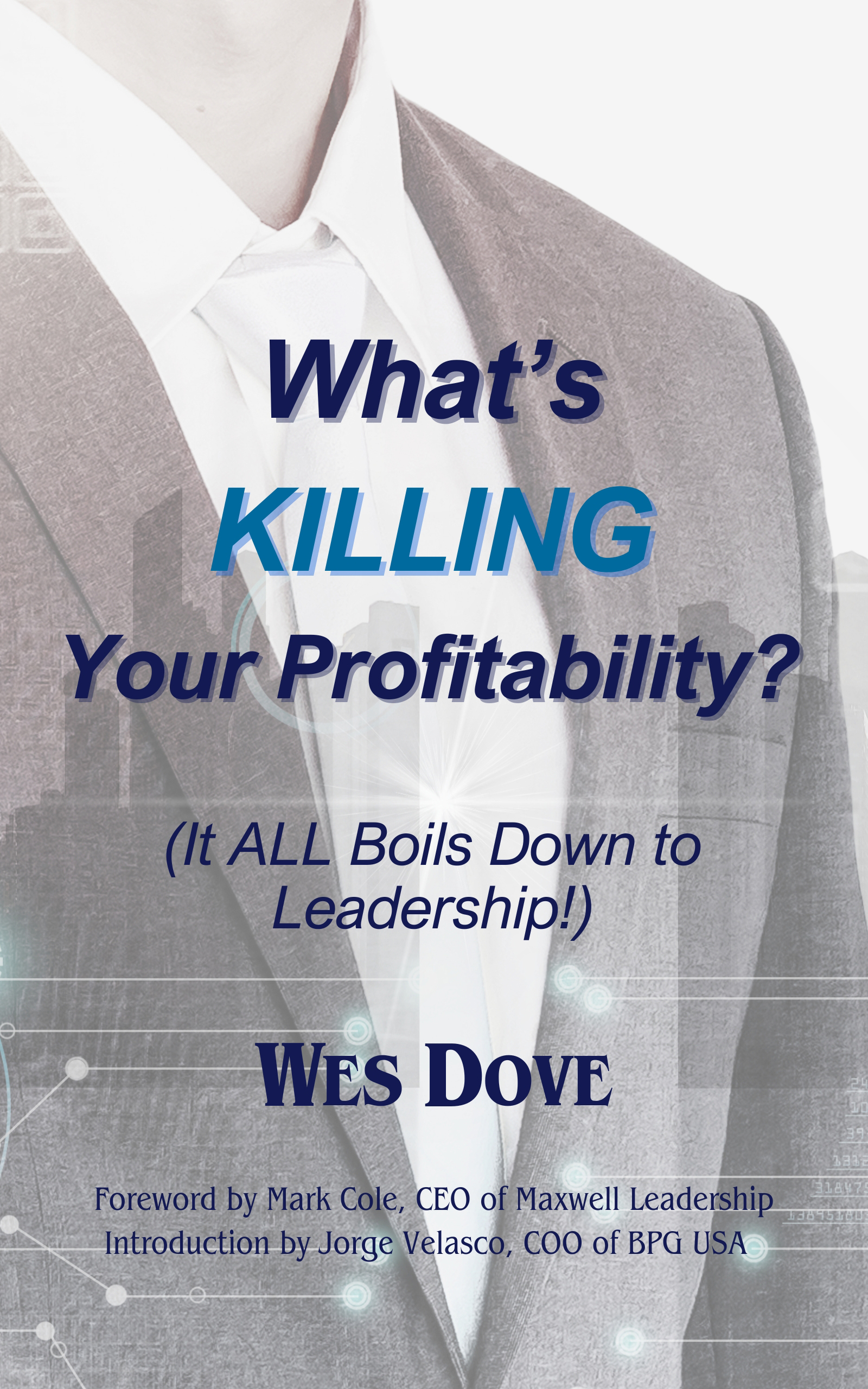
What’s KILLING Your Profitability?
It ALL Boils Down to Leadership!
Very early in my career, I bid on and accepted a position facilitating a behavior-based safety process in a large manufacturing facility similar to the one where Cindy worked, where they measured the air. The human resources manager who headed up our department focused on measurable results. While that wasn’t an odd focus for the parts fabrication department I started in, it was different in an initiative so tied to prevention; how do you measure injuries that don’t happen? Even in my mid-twenties and being new to that role, he never allowed me to use the intangible excuse. I fell short of his expectations more than I care to admit, but it taught me to do everything in my power to track exactly how anything I worked to implement (positively) impacted the departments we supported. Showing an increase in productivity and profitability was expected for me to remain employed.
During the two decades I worked directly in safety and human resources, I developed a strong intuition for what increased productivity and profitability, and I developed a keen eye for what cut directly into both. That skill set served me well, but it wasn’t until I started the manuscript for What’s Killing Your Profitability? that I dedicated real time to finding data that backed what I had experienced. I could feel the difference when I worked with actively engaged employees. In “The Things They Do for Love,” Leigh Buchanan provided the hard statistics behind that: “Increased commitment can lead to a 57% improvement in discretionary effort… That greater effort produces, on average, a 20% individual performance improvement.” In a HuffPost Canada article, Gerard Seijts detailed a Wells Fargo class-action suit — one that hit very close to home since it cost Cindy and me around $10,000 at a time when we were so broke we could barely pay attention. A paragraph in that article opened by sharing, “Failing to [assess] leadership character can clearly be expensive,” and went on to cite nearly $10 BILLION in total losses. One from Forbes.com called “Leadership and What It’s Costing Your Business” put it this way: “When you have poor leadership in management positions, it affects not only the morale of your business and the productivity of your team but also your bottom line in your business.”
Leadership was never intangible. It has ALWAYS been a line item; most organizations just kept filing it somewhere else. Thank God my HR manager pushed me to pay attention for so many years, long before I even had a concept for why productivity and profitability mattered so much. Even more than the Friday evening call with my CEO-friend, that experience provided me with the foundation for writing my first book. The case that people drive profit is already made and already sourced. What has been missing is not the argument — it’s the instrument. Before we get to the instrument, Cindy’s going to show you what that gap looks like inside a single building. Now, though, I’ll challenge you to find one number in your own business you have privately blamed on “the market” or “the workforce” this year. Ask what a leadership explanation for it would look like.
“Leadership was never intangible. It has ALWAYS been a line item; most organizations just kept filing it somewhere else.”
Two Managers, One Building
By Cindy Dove
For a season of my career, I set up meeting rooms at a large hospital. Every room had to be ready, down to the last chair, before the first person walked through the door.
I worked days, and now and then I picked up a second shift. Same building. Same rooms. Same tables and chairs. Same work. Different supervisor.
That was the only difference, and it changed everything.
My day supervisor gave us a picture before we ever touched a chair. “When you walk in, on your left is a trash can. There are two food tables. Look straight ahead. There’s a resource table, and beside it a water tower and another trash can. Turn and you’ll see the screen. The room is set up in a U-shape. Forty chairs. At the far door, a water tower and a trash can.” Then she handed it to us in writing.
We could see success before we built it. That left very little room for error. If a room was wrong, either you hadn’t paid attention or you hadn’t done the job.
When someone got it wrong, she told them, kindly and right away. “I appreciate everything you do here. The team really likes you, and I appreciate the extra shifts you pick up. But when it’s time for your review, I don’t want to talk about anything but the good things you’ve been doing. So I want you to know now: twenty chairs instead of forty isn’t a mistake we can make more than once. Log it wherever you need to, and we’re good to go.”
No grudge. No lecture. Clear, caring and done.
Second shift ran differently. Nothing was written down. The instruction was, “Get with the two leads. They’ve got all the information.” They were good people who liked to goof off, and those of us who came to work spent our time tracking them down just to learn which room and what setup. Rooms were late. Rooms were wrong. The complaints came in.
Then she gathered us up. “Come on now, you’re making me look bad. You guys don’t want to get me in trouble, do you? I don’t want to hear more complaints.”
She meant it. She wanted the complaints to stop. But nothing happened after that. Nobody had to log anything. The next night looked like the last one.
Same building. Same rooms. Same chairs. One shift got it right. The other got complaints.
Here is the part that stays with me.
Everyone knew. Moving around the hospital setting up rooms, we’d overhear the department managers and operations staff who booked them: “Have day shift set it up, or you’ll be dealing with a mess.” So they did.
The team doing the job well was handed more of it. The team that wasn’t was handed less. And when day shift couldn’t keep up, the answer was to hire more people for day shift, not to hold second shift accountable.
None of that showed up as a leadership problem. The requests were logged. The complaints were handled one at a time. The new hires showed up as headcount. As far as I ever knew, nobody lined the two shifts up side by side or asked who was leading them. Everyone just worked around it.
We could count the chairs in every room down to the last one. Nobody ever counted the difference between the two people leading those shifts.
Swap the chairs for sales calls, patient charts or job sites, and the two shifts for two departments in your own organization, and you’ve likely seen the same two leaders. I have, in organizations of every size and at every level.
The workaround looks like a solution. It is really the cost of a leader nobody measured, paid for in extra hires and by the people doing the job well.

The Framework
The People Optimization System
Optimization Guides for every pillar — practical systems that move what we teach from good ideas to repeatable action.
* * *
The difference between your best leader and your worst is already in your numbers. It is just showing up anonymously.
So here is my question for you. Think of the best and the worst leader you have worked with. Write down one thing that was measurably different between them. Then ask whether your organization captures it today.
If it doesn’t, most organizations are in the same place. Their best and worst leaders look identical on paper. That doesn’t mean you have to stay there.
“The difference between your best leader and your worst is already in your numbers. It is just showing up anonymously.”
90-DAY GUIDE: Lead Your Team Through Any Leadership Challenge
Did You Know?
Growing your leadership acumen is the fastest way to equip your team to lead through today's leadership challenges.
We've been equipping leaders like you for decades. We know you do not need another theory. You need a clear starting point and a simple system. This guide gives you both.
Download the Leadership Depth Playbook
Includes a 90-day action plan.
Just want the newsletter?
Skip the guide and get the monthly Resource Guide by email — leadership insights, no strings attached.
Already a leader who wants more?
200+ leadership lessons, live sessions twice a month with Wes & Cindy, and SHRM/HRCI credit for every lesson.
Try Leading At The Next Level Free for 14 Days »