
The Illusion of “Fine” - When Mediocrity Masquerades as Stability
I opened Leading With A Clear Purpose by sharing how a conversation with a lifelong friend gave me an acute understanding for how even the toughest among us can feel empty or burned out when the work they’re doing no longer provides them with fulfillment. In telling that story, I mentioned how he and I traded punches one evening after getting off the school bus, and that initiating what’s become one of the most longstanding and meaningful friendships I’ve ever had. Looking back now on our scuffle, I can definitely see how it served as a seed to much greater benefit. At the time, all I knew was that it left me with a sore head.

I wasn’t necessarily a bad kid; I didn’t get into a lot of trouble, but I certainly had what many would call a mischievous streak. Today, I know much of that was tied to my highly DRIVEN behavioral style; I love a challenge and get bored easily. If life isn’t moving fast enough and I’m not calling as many shots as I possibly can, I’m looking for something else to get into. As a teenager in a small town, that indeed resulted in more than a little mischief.

I earned great grades through elementary school and middle school. Even my first two years of high school were solid. I’ve never considered myself as overly intelligent, but I also never had to really apply myself to maintain those grades - which usually resulted in me not feeling challenged and having more time on my hands than many of my peers who had to study harder to keep up. As the saying goes, idle time can quickly become the devil’s playground…
I remember the first time a childhood friend and I found a six pack of beer hidden in a small creek near his house, I was maybe eleven or twelve. We claimed it as our own - because we knew we weren’t supposed to have it - and relocated it to an old shed behind his house. Unlike the first cold sips we had after retrieving it from the creek, it was warm from there on and just plain nasty; nothing I had any desire to try again, at least for a while.
Around fourteen or so, about the same time I picked up my first regular summer job, I began hanging out with a few of the older kids in the neighborhood. Video games were just catching on in those days, but we were more interested in doing anything we could outside. And the various activities we engaged in often involved tobacco and beer. I didn’t really like either at first, but peer pressure is a real thing. Even if there’s no direct push, we all want to belong (just ask Maslow). In those days, though, choking down two or three beers was a free ticket to stumbling around, and four or more almost guaranteed getting sick. Throw a dip of snuff in the mix and throwing up happened much sooner.
As over-the-line as that was for kids our age, we managed to keep ourselves out of any significant trouble - largely by staying off the radar of the adults who would have introduced their feet to our asses. And through the first few years of that, I maintained good grades and reasonable engagement in school. Looking back, that was absolutely mediocrity masquerading as stability, the illusion that everything was fine. In 2011, The Napoleon Hill Foundation released a book Hill wrote years prior called Outwitting the Devil, which included a chapter called “Drifting with the Devil.” I didn’t realize it as a young teenager, but drifting is incredibly dangerous. Bad situations don’t always announce themselves loudly; spotting the illusion of stability early allows us to extract seeds of greater benefit before things worsen - if we look for them. I was not doing that then.
We’ll look at how bad daily choices court disaster next, even when no single choice is inherently awful. Before that, though, I’ll challenge you to reflect on a current “fine” area in your life or work and jot down one way it might be masking a bad situation. Then identify one small step you can take right away to address it.
Daily Choices That Court Disaster
Through the midpoint of my freshman year in high school, I remember very few report cards that had so much as a C - and I don’t think I ever got anything lower. While I never did a ton of studying, I did carry books home as needed and completed homework assignments. When the second semester of my freshman year began, that ended. Although there may have been times where a textbook left school property in my possession, I can’t point to any substantial amount of attention it received. What I do have a fairly clear recollection of is all the extracurricular activities (work and shenanigans) I engaged in after school and on the weekends.
Working whenever and wherever I could minimized the time I had to engage in nonsense. Keeping a relatively low profile during said nonsense (and thank God for being raised with a “spare the rod, spoil the child” approach) helped me avoid getting into any significant trouble; fear can be a powerful motivator when good decisions are few and far between. Rather than A’s and B’s, most of my grades fell to B’s and C’s with an occasional D - something that never happened previously. Math always came easy, so that was consistently an A+, which helped keep my GPA respectable. English and Science required me to actually pay attention and called for study time beyond the classroom; I wasn’t interested in either and I refused to take part but managed to scrape by through my sophomore year.
I worked full time the summer between my sophomore and junior years. That, coincidentally, was the first summer I had a driver’s license and vehicle of my own. To say that summer was a whirlwind would be quite the understatement. As I mentioned before, I couldn’t work with the construction crew during the school year since they wrapped up their day shortly after I got out of class, so I got a job at the local grocery store. I was bagging groceries and pushing shopping carts initially, but I jumped at any chance they offered to learn other tasks. During the fall of my junior year, I averaged twenty or so hours on the job each week. I was new, I still attended an occasional high school football or basketball game, and I enjoyed hunting (or at least the social aspects of the hunting camp experience), so that was enough.
By January 1993, going into the spring semester of my junior year, I had grown far less interested in anything to do with school and was picking up all the hours I was allowed to work in the grocery store. I was even more engaged in shenanigans, which meant I had little time left for anything remotely tied to school work. Leading up to that point, I did really well when I was physically in the classroom and that offset my utter refusal to do homework. Attending school from 8a to 3p, working from 4p to 10p three to four evenings a week and pulling shifts on the weekends, all while participating in as much nonsense as I could find left little time for sleep. I soon learned that my English and Chemistry classes were best suited for squeezing in naps.
While I didn’t catch much flack from my teachers daily, I recall distinct conversations with each near the end of my junior year where I was presented with ultimatums. My English teacher explained that I would need to get an A on the final exam to pass for the year. And since it was a required class, failing would mean summer school. My Chemistry teacher was a wonderful lady but less positive in the message she shared. She said that I had a very slim chance of getting a D for the year but asked me not to repeat the class as a senior if I didn’t pass. Since that was not a required class, I assured her that she had nothing to worry about. Somehow, I managed a D. I still wonder if I really earned it or if that was her way of making sure one year of me was all she’d ever have to endure. As for English, I aced the final. 100%!!! The teacher wasn’t amused; not because I did so well, but because I gave the class no effort whatsoever leading up to that point when I was clearly capable.
High school turned from mediocrity to near-disaster (at least as it related to pass/fail, which I had never experienced before), all because of poor daily choices. The real bad situation wasn’t the external chaos, that still looked like stability for the most part, but the internal failure to lead myself; failure to identify the smallest seeds and pull lessons in accountability from what could have easily been the brink of disaster. Learning from even this minor adversity early on could have redefined how I would have approached more significant struggles moving forward. And more certainly followed…
Here’s the thing: Cumulative small bad decisions create big bad situations, but they can also provide seeds of resilience if we’re willing to face them head-on. Next, we’ll look at the risks that come with knowing better but still choosing to do less. Until then, I want you to identify one “brink” moment from your past (or present) and write it down. What risky choice contributed to it and commit to one alternative action you can take the next time you face a similar situation.
The Sting of Untapped Potential
One of my earliest memories of the behavior-based safety concept was hearing Terry Ward say that no one wakes up in the morning and decides they’re going to lose a body part in an industrial accident later that day. But because of at-risk behaviors, often behaviors they’ve practiced for years without so much as a near miss, people experience those types of significant injuries every single day. Even with the amazing technology engineered into manufacturing processes, the “people factor” still exists. Before moving on, let me be very clear: that “people factor” is also where we as leaders have tremendous opportunities to impact lives and capture incredible profitability for our organizations - which is also based completely on the behaviors WE choose daily.
I first heard Terry share that idea in my early to mid 20s. I suppose I could be that guy who says I wish I would have heard it years earlier, but I’m not sure I would have listened. I’m completely convinced that I heard it exactly when I was meant to hear it and the poor choices I made through my teens provided me with the lens I needed to receive that message. While I still maintained a picture of stability, even after what should have served as a wake up call by nearly failing Chemistry and English my junior year, my daily choices didn’t change. If anything, the choices compounded - just in the wrong direction.
I pushed the clutch all the way to the floorboard my senior year. I already had all the required credits I’d need if I chose the college path, which I had no intention of at that point. Had I pushed myself, I could have graduated high school with four college courses under my belt; the most available at the time. I had no desire to participate in such stuff, though! There were two classes left that were mandatory for graduation, some version of twelfth grade English and US Government. I opted for the most remedial available in both and enrolled in the Industrial Cooperative Training class so I could leave school at noon and work the rest of the day. Looking back, what I learned in that class has served me as much as any I’ve ever taken, even if I didn’t absorb it all at the time.
Saying I drifted through my senior year doesn’t come close to describing it. As long as I showed up, I was good to go. And that was actually a requirement for me to be allowed to work; if I missed school, my employer wasn’t supposed to allow me to work that day either. Some of my peers in those classes chose to skip the occasional class, and usually got away with it. I did not, I was getting nearly as much sleep at school as I did at home.
During that final year of high school, I got to work around 1p most days and worked until around 10 or 10:30p. From there, I’d head straight to the local hangout spots or to catch up with older friends, largely because I knew the chances of convincing someone to buy me beer was solid in either case. Those shenanigans often went on until the wee hours of the morning before I headed home for a few hours, only to do it all over the next day. And the next…
The extended naps at school meant I showed up to work fresh and ready to take on the world. I worked circles around most of the kids my age, all the college students employed at the same store (but that’s a story for another time), and many of the adults. I earned my first promotion, which came with a twenty-five percent pay increase, while I was still sixteen years old. The company offered me a full time position with a complete benefits package when I was seventeen, something that was (and still is) unheard of. All that said, I wasn’t applying anything close to what I was capable of at school - and I knew it. Even when it’s subconscious, there’s a bit of sting in knowing your potential is going untapped. And untapped potential in bad situations stings the most because it reveals our role in the outcome; owning it unlocks the lessons in personal responsibility (even when it takes us years to discover those lessons).
Looking back more than three decades, I can point to some of the most powerful lessons I’ve ever learned coming from my ICT class as a senior in high school and the two years I worked for that grocery store chain. Seeds, however, do not grow themselves - especially when we’re not even looking for them. We’ll dig into that next. Before then, I want you to think of a time you knew better but did less (like I did through basically every class my last three years of high school). Share the story with someone you trust completely and ask for their perspective on a hidden lesson you might have missed.
90-DAY GUIDE: Lead Your Team Through Any Leadership Challenge
Did You Know?
Growing your leadership acumen is the fastest way to equip your team to lead through today's leadership challenges.
We've been equipping leaders like you for decades. We know you do not need another theory. You need a clear starting point and a simple system. This guide gives you both.
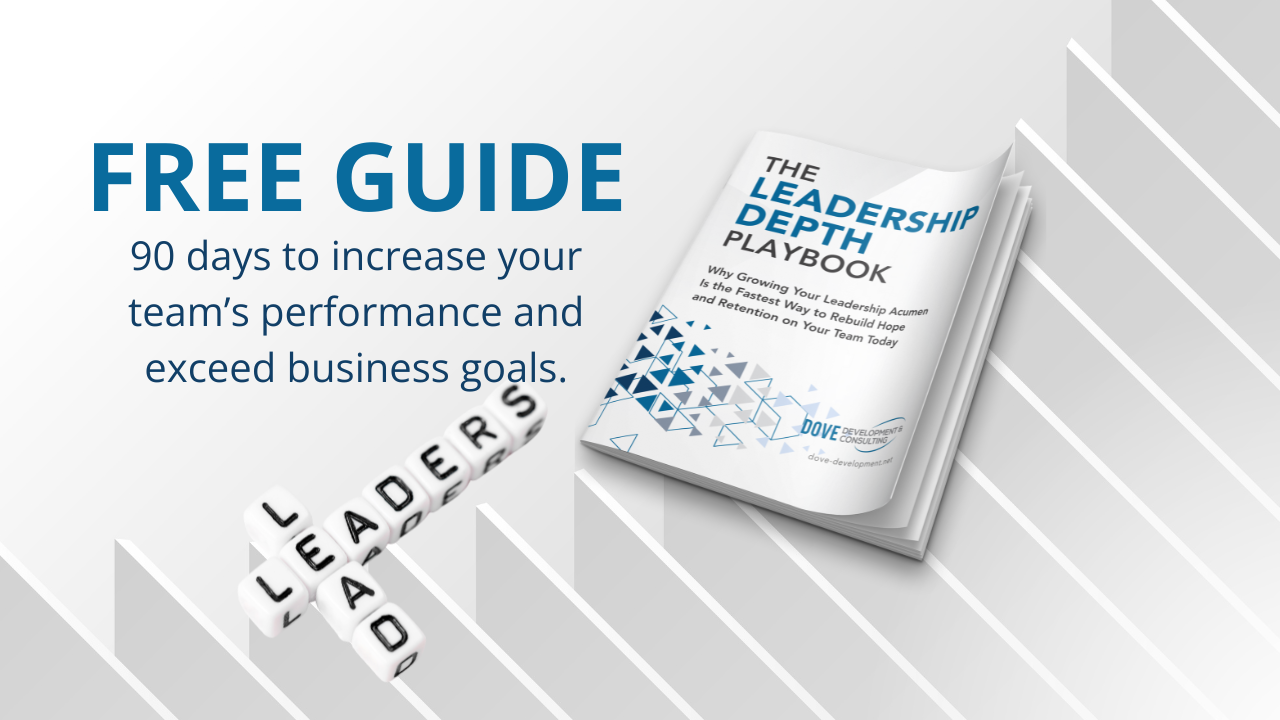
Download the Leadership Depth Playbook
Includes a 90-day action plan.