
Self-Control and a Pleasing Personality in Chaos
Nearly every time Cindy and I help a group learn to understand the science backing the DISC Model of Human Behavior, I explain how my behavior and communication changes from a heavy focus on results with a solid mix of fun and attention to detail when things going smoothly to full-on results when the stuff hits the fan. At that point, I don’t much care whether anyone has fun or if anything is accurate - as long as we get something done. I also share that I’m never really that patient. While I tell that story (somewhat) in jest, it captures the essence of how I’m wired on cruise control and how that changes when I’m under stress. I always add to all that by saying that I’d get a tremendous amount of work done if I were in business by myself; with Cindy as my business partner, though, there’s a chance that work will be correct and a chance people will actually like it.
Make no mistake, the eighteen months that followed March 11, 2020 (when that first call came through postponing the work we had put so much energy into getting booked in the first place) brought an ever-increasing amount of stress. My natural inclination would have been to push through every barrier that got in our way, details, feelings, and government mandates be damned! By then, though, Cindy and I had around fifteen years of studying Napoleon Hill’s leadership attributes under our belts. While it certainly wasn’t easy, we had a foundation for applying the second - self-control - when it mattered most. And quite honestly, each adversity we had lived through leading up to that helped prepare us. A more difficult attribute to practice, especially under the stress that comes when you’re self employed and prohibited from doing the work you get paid to do, was maintaining a pleasing personality - Hill’s seventh leadership attribute.
He defined that by saying “No slovenly, careless person can become a successful leader. Leadership calls for respect. Followers will not respect a leader who does not grade high on all the factors of a pleasing personality.” I wouldn’t have chosen “slovenly” to describe myself, but I am more than capable of becoming careless under stress. By exhibiting a bit of self-control, allowing Cindy’s C/SD behavioral style blend to guide me when I needed it most, I was (usually) able to fend off my carelessness and minimize the gruff tone I used with anyone who came near my mandatory six-foot bubble.
For clarity here, a pleasing personality isn’t forced cheerfulness—it’s the disciplined choice to remain approachable, optimistic, and service-oriented when everything feels bleak. We sent two (maybe three) invoices in the last six months of 2020. This was a 180 degree turn from where we thought we were headed on March 10, and that was about as bleak a picture as we had seen to that point in our business. Even the annual event we had hosted for five years took a wildly different shape. We’ll work through a few of the challenges that brought our way as well as the seeds we pulled from them next. Before we do, I want you to consider how you’ve been able to apply the leadership attributes I mentioned here, self-control and a pleasing personality, especially when you were faced with a major disruption. What seed of great relational influence might still be hidden? Detail one small nurturing action you can put in place to take full advantage of the greater benefit inside it?
From In-Person Rooms to Screens and Zoom
Through our first several years of attending the semi-annual International Maxwell Conference, where we completed our initial licensing with Maxwell Leadership then pursued all the continuing education and mentorship we could absorb, Cindy and I were very intentional to get involved behind the scenes wherever we had opportunities. Not only did we want to give back to the organization we had learned so much from, we knew it would provide experience we’d be able to apply as we hosted events of our own. And it absolutely did. Not so long ago, I was talking with someone and mentioned the 500+ hours Cindy and I put into each of the annual events we had hosted since 2015. He looked at me like I had an elbow growing out of my forehead and asked, “Why do you put so much time into it?” I responded by saying “You’ve never done something like that, have you?” He clearly had not… Having just limited involvement in room set-up, run-of-show, and various other pieces of a three-thousand person event taught us a ton about what we’d need to do for 200-300 people in our rooms, especially when the team handling all the details (and finances) leading up our events consisted of only me and Cindy.
We’ll circle back to a few other seeds we’ve since pulled for the many adversities we faced as event hosts. For now, let’s stick to how tough maintaining self-control and a pleasing personality can be when you go from selling out a room for 225 attendees six weeks prior to the 2019 event to being capped at a maximum of 50 people on the premises the following year. What folks who have never planned or hosted events like this often don’t realize is that many of the arrangements have to be made six months to a year in advance; the venue, catering, licensing, and support for the day of. None of that happens a few days or even a few weeks before the event. In 2020, we had all that in place by the end of February. When all our existing plans began to evaporate on March 11, our costs - as well as our obligations to our partners - were still very real.
Cindy and I were using tools like Zoom long before it was cool, so we didn’t experience the personal learning curve that many others did when the lockdowns started. Quite honestly, using virtual tools served as the seed for our January 2020 conversation with DPOR and led to us becoming approved recertification providers with SHRM and HRCI. However, we had been doing sessions with small groups, not hosting events for hundreds of people. Not only were we now responsible for figuring out how to do that for our clients and partners locally, we were also serving as volunteers who supported several hundred other folks around the world who hosted events similar to what we had been doing.
That volunteer role provided more opportunities to look for seeds in a short period of time than I could have imagined. For times sake, I won’t go cover all that in detail here, but I will share that even an organization with the strongest history and clearly stated values can suffer significantly when just one person in a key role chooses to skirt those values to appease a select few. And as frustrating as that was to deal with in a volunteer role, Cindy and I pulled a powerful lesson from it that’s opened doors to far greater opportunities ever since. It also helped us know exactly what we needed to do to deliver the best possible experience for our event locally in October 2020.
Regardless of the cap on attendance, twenty percent of what the same room held in previous years with several added expenses we didn’t have before or since, we pushed forward. Just in case you’re wondering, we still have a few boxes of N95 masks and a case or two of hand sanitizer left over all these years later. Pivot was the buzzword of the year, and pivot we did. We didn’t make a profit on that event, and I’m fairly sure we didn’t even cover our costs, but the people who were able to join us had a great experience. And like we were doing with each of our more focused courses - Emerging Leadership Development, Leading At The Next Level, and our still new Executive Leadership Elite Think Tank - we found ways to move from just in-person rooms to screens and Zoom.
Definiteness of plans and mastery of detail, two of the leadership attributes we’ve looked at repeatedly leading up to this point, had become survival skills. Thankfully, we had been honing those skills through other adversities for years by then and were prepared to pivot with the best of them. The habit of doing more than paid for was alive and well, too, especially considering the painfully small amount we invoiced in the final half of 2020, and it allowed us to keep the influence we had worked so hard to earn alive when the model we had been leaning on disappeared almost overnight.
Driving away from that small in-person event, we knew we did everything we could to deliver an exceptional experience. We closed the year by offering similar experiences virtually a few more times, publicly and for a couple of private groups. But the cash register still wasn’t ringing so we had some tough decisions to make. We’ll look at some of those next. Before that, I’ll challenge you to identify a current delivery or communication method you depend on that could actually be fragile. If you suddenly found yourself in a scenario like we did with our event in 2020, what’s one clear step you could take immediately to be more adaptable?
Responsibility for Backing Our Definite Decisions
That decision I made in early March 2020 to step away from the security of a supplemental W2 role so we could put our complete focus on the opportunities that were showing up on a weekly basis was a big one. Sticking with that decision when it came time to live it out at the end of May was a taller order, especially since what had been touted as “two weeks to flatten the curve” had since stretched to two months and restrictions were only getting tighter. Providing virtual sessions for clients whose worlds were just as upside down as ours added to the adversities we were working through, before we ever had the chance to host our annual full-day event for just 40 attendees - in the same room where we had squeezed in 225 just twelve months prior.
As we moved into the final months of the year, I knew we needed to find options for generating income but I didn’t want to take too many steps back from all we had been doing to build the foundation of our business around. While 2020 was anything but profitable, Cindy and I had developed a tremendous amount of resources that have served us and our clients ever since. Stepping back into a full time or part time role in safety and human resources would have pulled much of my focus away from that. Through that same time, though, I did provide limited safety and HR support to a couple of small businesses where we had close relationships with the owners and executive teams. That was all on an as-needed, 1099 basis. While the revenue was sparse, it was revenue - and we had very few other options for generating it anywhere else at that point.
I shared the idea that I had limited capacity to support a few more small businesses like that through our network of clients and with members of our Executive Leadership Elite Think Tank. That didn’t set the world on fire, but one led to another, then another, and that was enough to keep our lights on. As thankful as I still am for each of those opportunities, I can point to so many lessons I learned in the process. Most were decent experiences - considering how much I had grown to dislike the day-to-day work involved in recruiting, safety, and human resources compliance work by that time. There were a few, however, that showed me (yet again) just how important it is to have a strong values-alignment with each client we serve. If the work itself doesn’t have a direct tie to the purpose we’re working toward, the values match becomes a must-have. Without either, the disconnects are bound to be frequent - and likely significant.
Sticking with the decision I made back in March required more willingness to accept full responsibility than maybe any other thing I had done to that point in my career. The highs and lows we worked through, especially the lows, served as the seeds that would clarify that values and purpose are stronger than any temporary security. Getting through the final months of 2020 in a business that was now our sole source of income, and was generating very little, was definitely a challenge we didn’t see coming. Consistency that we had always worked to model, coupled with all Cindy did (and continues to do) to help me maintain a pleasing personality, honed our delivery through the disruption. Before I share some of the amazing opportunities that came from that, I want you to pinpoint one area where you’re still relying on something that’s really a temporary solution. What can you do right away to move toward permanent alignment so you’re not in a spot where you’re wondering how to keep the lights on?
90-DAY GUIDE: Lead Your Team Through Any Leadership Challenge
Did You Know?
Growing your leadership acumen is the fastest way to equip your team to lead through today's leadership challenges.
We've been equipping leaders like you for decades. We know you do not need another theory. You need a clear starting point and a simple system. This guide gives you both.
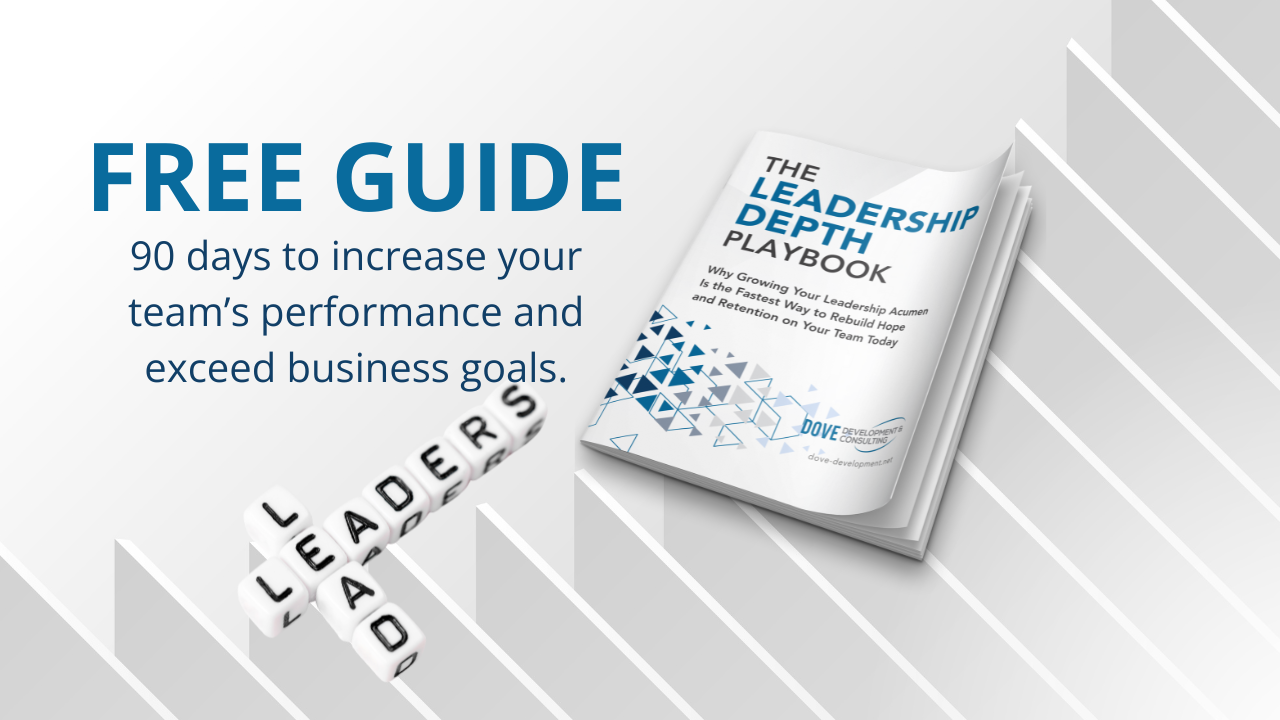
Download the Leadership Depth Playbook
Includes a 90-day action plan.